What Is SMA Certification and Why Does It Matter for Industrial Work Platforms?
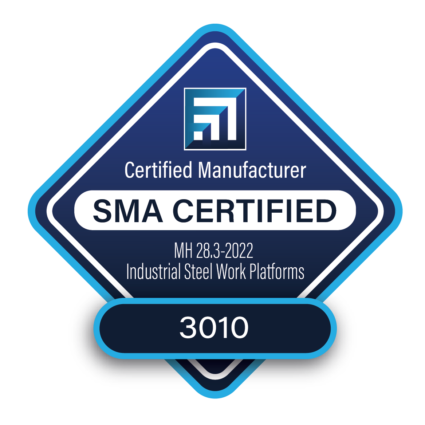
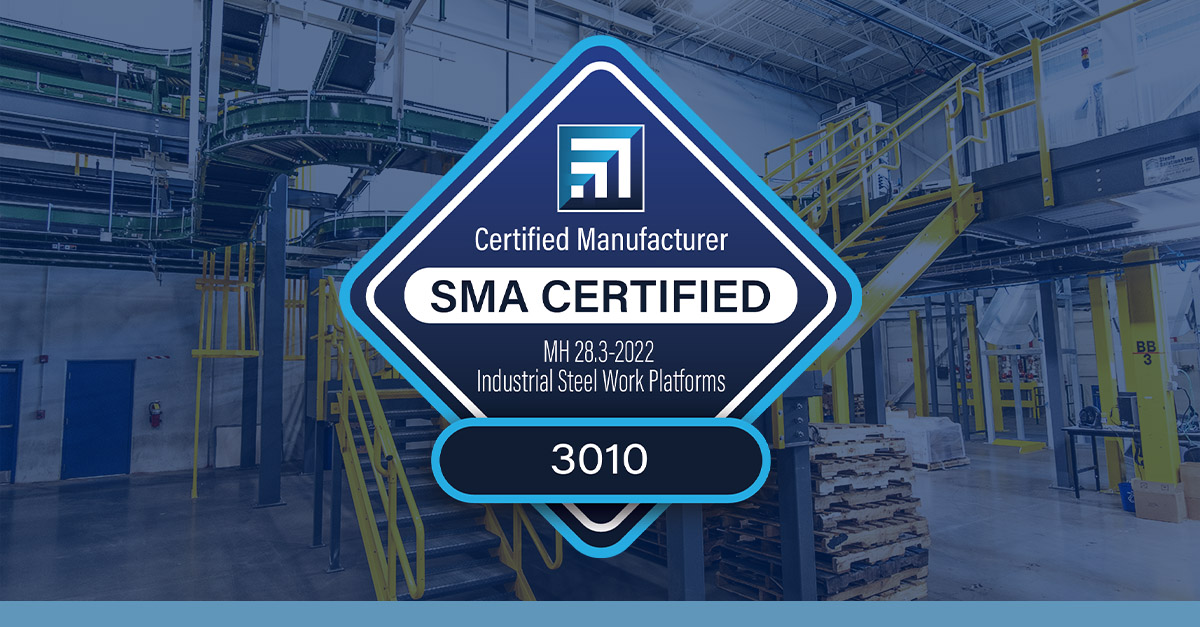
Steele Solutions recently became the first manufacturer to earn the Storage Manufacturers Association certification — but the real story isn’t the achievement itself. The important question is: What does SMA Certification mean for customers?
Let’s review the certification and how it’s supporting the material handling industry.
What Is SMA Certification?
SMA Certification is a third-party certification program developed by the Storage Manufacturers Association, an industry group operating within MHI (Material Handling Industry). It applies specifically to industrial work platforms, the structures supporting personnel, equipment, and material handling operations above the warehouse floor.
The certification is built around ANSI MH28.3, the industry standard governing the design and fabrication of industrial work platforms.
Steele Solutions demonstrated through an independent outside review how our platforms are engineered and manufactured to meet this SMA certification standard.
Why Was SMA Certification Created?
Industrial work platforms occupy an ambiguous space within the International Building Code.
Not classified as equipment, nor as buildings, industrial work platforms exist in a no-man’s land without any available design or fabrication evaluation framework. Until ANSI MH28.3 was established, project teams and building officials had to apply whatever standard came closest.
ANSI MH28.3 was purposely developed to address this gap, and the process took roughly a decade of industry collaboration. This effort culminated in its recent adoption as a referenced standard in the International Building Code, providing code officials with a defined framework for evaluating industrial work platforms.
A standard is only effective if manufacturers actually build to it. SMA Certification exists to confirm that manufacturers do. It is the mechanism verifying that a manufacturer is designing, testing, and fabricating in accordance with ANSI MH28.3.
As the first manufacturer to obtain SMA certification, Steele Solutions is leading the way in showing customers what verification means in practice.
What Does SMA Certification Mean for Customers?
For customers, SMA Certification translates into five assurances.
1. Greater Engineering Confidence
Every certified industrial work platform is engineered to a recognized, code-referenced standard rather than an internal benchmark set by the manufacturer. The engineering calculations behind each design must meet the same standard now referenced by building officials.
2. Independent Third-Party Validation
SMA Certification provides independent confirmation that an industrial work platform meets the applicable standards rather than just what is claimed in a company’s marketing materials. A licensed third-party engineer reviews the manufacturer’s calculations and verifies compliance, assuring customers of an independent, outside validation of the product.
3. Consistent Quality
Certification extends beyond design to cover:
- Engineering
- Testing
- Manufacturing
Additionally, certification extends to cover the quality management system connecting all three of these elements. A well-engineered platform can still fail in the field if fabrication is inconsistent, so SMA Certification evaluates the full process, not just the project documents.
4. Reduced Project Risk
Specifying a platform is, in effect, a bet on the manufacturer’s process. A certified manufacturer gives project teams something concrete to reference: a recognized, independently verified standard, rather than unconfirmed assurances about a product.
5. Long-Term Reliability
ANSI MH28.3 addresses more than how a platform performs on the day it is installed. The standard accounts for the daily loads and conditions the platform will encounter while in operation, requiring managers to consider long-term performance during the engineering and fabrication process.
How Does a Manufacturer Earn SMA Certification?
Earning SMA Certification requires a manufacturer to demonstrate four things, each subject to independent review:
- Independent design review: Engineering calculations for the platform design must be submitted to and reviewed by an independent licensed engineer with no financial interest in the outcome, who confirms compliance with ANSI MH28.3.
- ISO-certified product testing: Product testing must be completed at an ISO-certified lab. Fabricated units are tested against the standard’s requirements, and this step is typically the most demanding part of the process. Building test units and securing lab time requires significant investment of both time and cost.
- Quality process and manufacturing management: A manufacturer must demonstrate a functioning quality management system and evidence of controlled, repeatable fabrication rather than being dependent on any individual crew or shift.
- Documented compliance: Adherence to ANSI MH28.3 must be maintained, from initial design through final fabrication.
SMA Certification is not a credential that a manufacturer earns once and sets aside. It represents verification of an entire engineering process, revisited on an ongoing basis.
The underlying ANSI MH28.3 standard will be revised roughly every four to five years, and manufacturers must continue to demonstrate compliance as it evolves.
Why Steele Solutions Was the First Manufacturer Certified
Becoming the first SMA-certified industrial work platform manufacturer reflects our three decades of work experience in the material handling industry, including direct involvement in developing ANSI MH28.3 itself.
Steele Solutions worked alongside other SMA member manufacturers for more than a decade to help develop, refine, and ultimately secure the standard’s adoption into the International Building Code.
Tyler Drouin, Senior Director of Engineering and Design for Platforms at Steele Solutions, chairs the SMA Engineering Committee, the group responsible for overseeing the standard. His role reflects an active hand in shaping industry direction, not simply participation in it.
“Customers are looking for more than a platform supplier—they’re looking for a trusted engineering partner,” says Drouin. “SMA Certification provides independent validation and gives customers confidence they’re receiving a safe, reliable, and engineered solution specifically for their application.”
A recent acquisition also brought new design standards and expanded fabrication capabilities at Steele Solutions, which meant product testing was already underway for other reasons.
Steele Solutions incorporated the requirements for SMA Certification into the existing testing process, addressing what is typically the most resource-intensive part of certification without starting from scratch.
“SMA certification reflects something that’s been at the core of Steele Solutions for 30 years — our commitment to engineering products the right way. We’re honored to be the first company to earn this distinction, but what makes it especially meaningful is what it represents for our customers: confidence that every platform is designed, tested, and manufactured to the highest industry standards.” – Kevin O’Neill, CEO
We view certification as an ongoing commitment rather than a finished achievement.
“As our industry continues to evolve, we’re committed to helping shape the standards that guide it,” Drouin says. “Being the first manufacturer to earn SMA Certification demonstrates that we’re not simply keeping pace with industry expectations, we’re helping define them.”
Talk to Our Team About Your Next Project
SMA Certification is a recent development, and many customers evaluating platform suppliers will not yet be familiar with it. The value in earning SMA Certification lies in what it confirms about a platform manufacturer and the products it produces for customers.
To discuss how SMA Certification applies to a current or upcoming project, contact us today. Our engineering team can walk through the specifics of the standard and how it applies to your platform requirements.